
Multi-Location Reputation Management: How to Scale Across Thousands of Locations
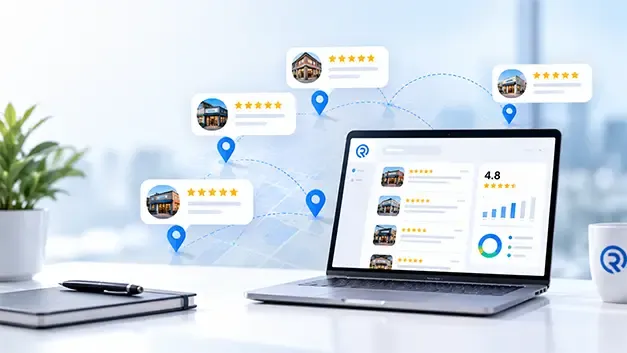
Imagine you run a 100-location business; one customer says your service is great, another is upset about a rude receptionist. Someone else reviewed your business somewhere, but your team hasn't seen it in three weeks. Good job. Yours is a reputation management issue; it comes with hundreds of addresses.
For a multi-branch or franchise business, building a good online reputation goes far beyond simply getting five-star reviews. It’s about ensuring that customers get a consistently good experience whether they walk into your Bengaluru showroom or Chennai clinic, or order from your Keralam outlet.
That’s why multi-location reputation management matters. But without hiring an army of social media managers, how do you scale it?
1. One Brand, Thousands of First Impressions
Your customers don’t experience your brand as a corporate logo or mission statement framed in the head office. They experience it at individual points. Some may love your brand but may not like the service at a specific outlet. The result: that outlet’s review can affect whether they choose another branch.
The constraint is to maintain consistent standards everywhere without sounding as if the same robot managed them. Begin with clear brand guidelines, response standards, and escalation paths. Let local teams respond organically while making sure the brand voice is still recognisable.
Ultimately, consistency doesn’t mean every customer receives the same copy-paste apology. It means each customer gets the same commitment to being heard.
2. Stop Playing Hide-and-Seek with Customer Reviews
When the number of branches is limited to 15-20 locations, it is not so difficult to manage the reviews manually, but if they outnumber 500 or 600 sites, then there is a problem. You will find it hectic to respond to every review manually. Imagine you come across reviews on various industry websites and digital channels, including Google Business Profiles and social media accounts like FB, Instagram, Twitter, Pinterest, and LinkedIn. It may be demanding to respond to every comment individually, and you may miss recurring concerns if you start addressing each location separately. Here, you reach a saturation point where your marketing team starts doubting their career choices.
This problem can be resolved with a centralised management system where you can track and manage reviews from multiple locations. Multilocation review management doesn’t mean you need to respond to every single review instantly; it is to ensure that the right feedback reaches the right customer before his/her complaint turns into a serious public controversy.
3. Let AI Do the Heavy Lifting, Not the Thinking
Artificial intelligence can lift the labour-intensive headache from your team by processing the huge volume of customer reviews within seconds. The tool is able to detect customer emotions and organise reviews into relevant categories, including flagging controversial complaints, recommending suitable responses, taking accountability, and thus improving productivity and uniformity. Instead of reading hundreds of reviews, managers can spot recurring problems such as inordinate delays, overpriced bills, or service flaws.
But the catch is: AI recognises an unhappy customer too. It can’t magically repair the broken air conditioning that left the customer unhappy in the first place. But it can resolve the issue with the help of human intervention.
However, any sensitive, complicated, or potentially harmful responses generated by AI should be reviewed, where a considerate, customised reply always beats the common robotic template ‘We regret the inconvenience caused’. The idea is to strip the labor out of work and free up people to deal with real issues.
4. Turn Reviews into a Business Intelligence Tool
More than just public comment, your reviews are free customer research, often delivered with a lot more honesty than a formal feedback survey.
Suppose there are 15 places where customers complain about slow service repeatedly. What does it imply: a staffing issue, improper training, or a broken operational process? Here is where the potential of AI-powered review management software lies. The tool can track trends across locations. At this point, reputation management becomes a business improvement strategy, rather than a marketing task on an already overloaded task list.
The software measures metrics such as average ratings, response times, review volume, recurring complaints, and improvements following corrective action. It compares locations, thus accounting for differences in customer volume and operating conditions. Above all, it shares insights with the teams who can act on them. Remember, a dashboard full of red flags is not a strategy; it's a very colourful cry for help.
5. Find the Right Balance Between Central Control and Local Freedom
Does the corporate team need to approve every response? Do dealership licensees need to take full ownership? Both are extreme.
If online visibility is a priority for the corporate team, flexibility to address daily customer concerns is the demand for local teams; hence, a powerful AI review management platform is key because it is capable of handling customer concerns effectively across multiple locations and can balance branding and local decision-making through unified review processing and administrative assistance.
However, validate whether tools like ReviuAI meet your digital demands across multiple locations, various social media channels, workflows, and reporting processes. The right tool should make things easier, not just add another complicated system for everyone to learn.
It's the technology that creates the framework; clear ownership makes it work.
6. Remember: A Five-Star Rating Isn't the Finish Line
A high score looks nice on a presentation slide. But what if customers keep coming back with the same unresolved problem?
Multi-Location Reputation Management’s real goal is to build trust at every customer touchpoint, which means asking for genuine feedback, responding thoughtfully, fixing recurring problems, and measuring customer expectations and satisfaction.
Don’t reward places that have a lot of positive reviews. Reward teams for listening and responding responsibly and improving service, because a five-star rating is only a result; it’s the consistency in delivering a good customer experience that makes your business sustainable.
Conclusion: Scale Your Listening, Not Just Your Locations
Business wins include scaling to thousands of locations; keeping thousands of good customer relationships is a whole other ball game. Successful businesses will leverage centralised systems, intelligent automation, local accountability, and genuine human empathy.
So before you open your next 20 locations, ask yourself this: If a customer complains at location number 12 today, will the right person know about it tomorrow? If the answer is no, you don't just have a reputation problem; you have an opportunity to build a smarter, more customer-focused business.
Frequently Asked Questions
1. What is multi-location reputation management?
It is the AI-driven process of administering, running, and improving the reputation of a business’s multiple outlets, including its dealerships, locations, and services.
2. How can businesses manage reviews across thousands of locations?
With the advantage of AI,
Customer comments can be collected from multiple outlets.
Review monitoring can be done and responded to promptly.
Sentiment-based reviews can be identified and responded.
Root cause analysis can be done, and corrective measures can be taken for recurring concerns.
3. How does AI improve reputation management for multi-location businesses?
Customer reviews are collected from multiple locations, reviewed, and responded to within seconds using AI-powered review management software. The tool helps detect recurring concerns, highlights them, and takes corrective measures to enhance customer trust and reputation management.